Five young students in Basecamp shirts smiling.

How It Works

Why bright kids stall in school - and what we do differently

First, the problem - with the data behind it. Then the method, what a

Basecamp session actually looks like, and the results.

Start with the problem

Dark brown abstract background with a subtle reddish gradient.

The Problem

Why do we still teach the way we did

100 years ago?

100 years ago?

100 years ago?

Classrooms have new screens, but the model underneath hasn’t changed: every child, same material, same pace. The results are showing.

Same model, different century. Here’s what that’s doing to students.

−35 pts

since 2003

Student performance has declined

Canadian students’ mathematics performance has fallen significantly since PISA testing began in 2003, reaching its lowest recorded level in 2022.

The challenge isn’t that every student is struggling. It’s that a classroom moving at one pace can’t always meet every student where they are.

Average Grade 8 math scores declined from 532 in 2003 to 497 in 2022.

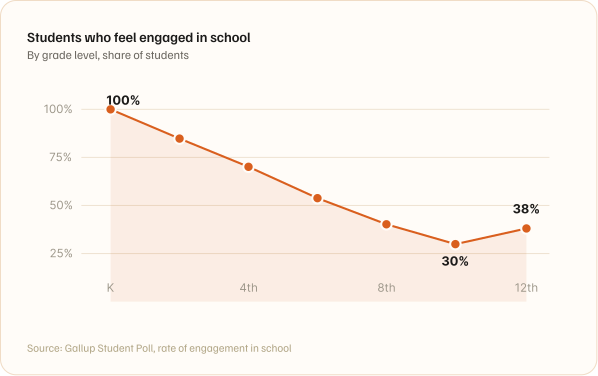
62%

drop in engagement from K-12

Engagement collapses as school goes on

Children begin life curious. Yet for many students, enthusiasm for learning decreases year after year — not because they stop being curious, but because school stops connecting to them.

When learning feels disconnected from a student’s needs and abilities, motivation follows.

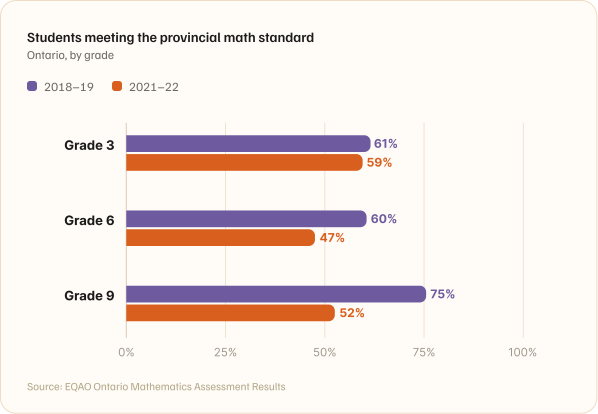
75% → 52%

Grade 9 math standard

Small gaps quietly become big ones

Gaps in understanding compound over time. What starts as one missed concept becomes years of frustration, lower confidence, and reduced academic performance — and the older students get, the wider the gap grows.
The system rarely goes back to close a gap. Basecamp starts there.

The Method

Why Basecamp Works

You’ve just seen what one-size-fits-all does to students. Here’s what we do instead — five principles, applied to one child at a time: yours.

01

Learning at the right pace

Every student works at the edge of their own ability — stretched enough to grow, supported enough to keep going. Never bored, never drowning.

Answers: the one-pace classroom

01

Learning at the right pace

Every student works at the edge of their own ability — stretched enough to grow, supported enough to keep going. Never bored, never drowning.

Answers: the one-pace classroom

01

Learning at the right pace

Every student works at the edge of their own ability — stretched enough to grow, supported enough to keep going. Never bored, never drowning.

Answers: the one-pace classroom

02

AI that adapts, people who decide

Our learning platform pinpoints exactly where your child is — every lesson, every gap — and adapts as they progress. Guides use that picture to decide what’s next. The AI informs; humans teach.

Answers: gaps that go unnoticed

02

AI that adapts, people who decide

Our learning platform pinpoints exactly where your child is — every lesson, every gap — and adapts as they progress. Guides use that picture to decide what’s next. The AI informs; humans teach.

Answers: gaps that go unnoticed

02

AI that adapts, people who decide

Our learning platform pinpoints exactly where your child is — every lesson, every gap — and adapts as they progress. Guides use that picture to decide what’s next. The AI informs; humans teach.

Answers: gaps that go unnoticed

02

AI that adapts, people who decide

Our learning platform pinpoints exactly where your child is — every lesson, every gap — and adapts as they progress. Guides use that picture to decide what’s next. The AI informs; humans teach.

Answers: gaps that go unnoticed

02

AI that adapts, people who decide

Our learning platform pinpoints exactly where your child is — every lesson, every gap — and adapts as they progress. Guides use that picture to decide what’s next. The AI informs; humans teach.

Answers: gaps that go unnoticed

03

Guides who care

With 3 students per guide, your child is genuinely known — their strengths, their stuck points, what makes them light up. Personal support, encouragement, and accountability from someone they trust.

Answers: disengagement

03

Guides who care

With 3 students per guide, your child is genuinely known — their strengths, their stuck points, what makes them light up. Personal support, encouragement, and accountability from someone they trust.

Answers: disengagement

03

Guides who care

With 3 students per guide, your child is genuinely known — their strengths, their stuck points, what makes them light up. Personal support, encouragement, and accountability from someone they trust.

Answers: disengagement

04

Strong foundations first

Before pushing forward, we go back — finding and closing the gaps that make everything after them harder. Mastery first, then speed. That’s how a year’s growth in months becomes possible.

Answers: compounding gaps

04

Strong foundations first

Before pushing forward, we go back — finding and closing the gaps that make everything after them harder. Mastery first, then speed. That’s how a year’s growth in months becomes possible.

Answers: compounding gaps

04

Strong foundations first

Before pushing forward, we go back — finding and closing the gaps that make everything after them harder. Mastery first, then speed. That’s how a year’s growth in months becomes possible.

Answers: compounding gaps

05

Skills for life

Communication, leadership, financial literacy, and independence are built into every week through workshops and real-world projects — not bolted on after academics.

Answers: school that stops at marks

05

Skills for life

Communication, leadership, financial literacy, and independence are built into every week through workshops and real-world projects — not bolted on after academics.

Answers: school that stops at marks

05

Skills for life

Communication, leadership, financial literacy, and independence are built into every week through workshops and real-world projects — not bolted on after academics.

Answers: school that stops at marks

05

Skills for life

Communication, leadership, financial literacy, and independence are built into every week through workshops and real-world projects — not bolted on after academics.

Answers: school that stops at marks

See the method work on your child

The best way to understand it is to watch it happen. Start with a free assessment — then experience a full month, on us.

Book Your Free Assessment →

See the method work on your child

The best way to understand it is to watch it happen. Start with a free assessment — then experience a full month, on us.

Book Your Free Assessment →

See the method work on your child

The best way to understand it is to watch it happen. Start with a free assessment — then experience a full month, on us.

Book Your Free Assessment →

The Role of Technology

Technology personalizes the practice.

A guide makes it meaningful.

Each does the one thing it’s best at. Neither replaces the other — and your child gets the benefit of both.

The Platform

Precision

The part software does better than any of us.

Knows exactly where your child is

Every lesson and every answer sharpens the picture of what’s mastered and what isn’t.

Adapts practice in real time

Problem by problem, the level adjusts — never too easy, never out of reach.

Catches gaps early

A missed concept surfaces in days — not on a report card months later.

The Guide

Meaning

The part only a person can do.

Turns practice into purpose

Guides connect the work to your child’s interests and goals — the difference between doing it and wanting to.

Decides what’s next

The platform suggests; a person who knows your child chooses — when to push, when to pause.

Builds the learner, not just the score

Confidence, communication, and independence grow through relationship — encouragement at stuck points, celebration at breakthroughs.

Your child is never just handed a screen. Here, screen time is guided practice — with a person beside them who knows exactly where they are.

Your child is never just handed a screen. Here, screen time is guided practice — with a person beside them who knows exactly where they are.

3 students per guide, every session.

Inside Basecamp

What happens in a session

No two students work on the same thing — but every session follows the same rhythm. Here’s a typical hour.

0–5 min

Check-in & today’s goal

Guide

Your child’s guide greets them by name, looks at where they left off, and sets one clear goal together. Small ritual, big effect — the session starts with intention, not a worksheet.

5–45 min

Working the plan, together

Guide + Plan

The heart of every session: your child works through their personalized learning plan with their guide right beside them. The plan adapts as they go — and the guide explains, encourages, and adjusts in the moment — so the work is always at exactly the right level.

45–55 min

Close a gap or push ahead

Guide

Based on what today surfaced, the guide decides: re-teach the concept that wobbled, or stretch into what’s next. This is where gaps close instead of compound.

55–60 min

Wrap-up & win of the day

Guide

The session ends the way it began — together. What moved forward today? What’s next session’s first step? Your child leaves knowing exactly what they accomplished.

Life skills get their own day

Skills-for-life workshops — communication, leadership, financial literacy, independence — run on separate days, so academic sessions stay focused and workshops get the time they deserve. Two kinds of growth, each with room to breathe.

The Results

Case study

What the method looks like when it meets a real student.

Grade 5 Mathematics

Grade 6 English

Challenge

A Grade 5 student consistently completed work ahead of classmates and had become disengaged, because the material was no longer challenging.

☰ Approach

01

Assessment

Assessment revealed the student was already performing above grade level in several strands of mathematics.

02

Personalized learning

An accelerated learning path allowed the student to progress beyond grade-level expectations while maintaining mastery.

03

Adaptive learning

The student’s pace and difficulty level continuously adjusted based on performance.

04

Guide support

Guides helped maintain motivation, challenge thinking, and encourage deeper problem solving.

✓ Outcome

The student remained highly engaged, continued progressing ahead of grade level, and developed greater confidence tackling advanced concepts.

Composite examples representative of the Basecamp learning model.

The Results

Case study

What the method looks like when it meets a real student.

Grade 5 Mathematics

Grade 6 English

Challenge

A Grade 5 student consistently completed work ahead of classmates and had become disengaged, because the material was no longer challenging.

☰ Approach

01

Assessment

Assessment revealed the student was already performing above grade level in several strands of mathematics.

02

Personalized learning

An accelerated learning path allowed the student to progress beyond grade-level expectations while maintaining mastery.

03

Adaptive learning

The student’s pace and difficulty level continuously adjusted based on performance.

04

Guide support

Guides helped maintain motivation, challenge thinking, and encourage deeper problem solving.

✓ Outcome

The student remained highly engaged, continued progressing ahead of grade level, and developed greater confidence tackling advanced concepts.

Composite examples representative of the Basecamp learning model.

See What’s Possible in 30 Days.

You’ve seen the method. Now watch it work on your child — a free assessment, a personalized plan, and a full complimentary month.

See What’s Possible in 30 Days.

You’ve seen the method. Now watch it work on your child — a free assessment, a personalized plan, and a full complimentary month.

©2026 Basecamp. All rights reserved.

Terms and Privacy

©2026 Basecamp. All rights reserved.

Terms and Privacy

©2026 Basecamp. All rights reserved.

Terms and Privacy